AI in Cars: How It's Changing the Way We Drive
Published October 30, 2026
AI has been quietly working its way into cars for the best part of a decade, starting with the cameras and sensors that got better at spotting things on the road.
Lately it's got a lot bolder: it's started holding actual conversations, not just following a few pre-set commands. It's in the voice assistant that gets your directions right first time, the camera watching for tired eyes at 2am, and the factory robot spotting a flaw even a trained eye could miss.
Self-driving cars are grabbing most of the headlines, but AI is already changing ordinary driving in ways most of us haven't clocked yet.
Want to cut through the jargon and get the full picture? Here's everything you need to know about AI technology in cars, from what's already on the road to what's coming next.
Get a free valuation
What is AI in cars?
'AI in cars' refers to software that spots patterns and makes judgement calls from data, rather than just following a fixed rule.
Cruise control and parking sensors don't count; they've run on fixed rules for decades. Newer AI tech is driven by machine learning, the same kind of technology behind speech and image recognition, trained on huge amounts of driving and manufacturing data to work things out on the fly, rather than just do its thing without asking why.
Self-driving cars and robotaxis
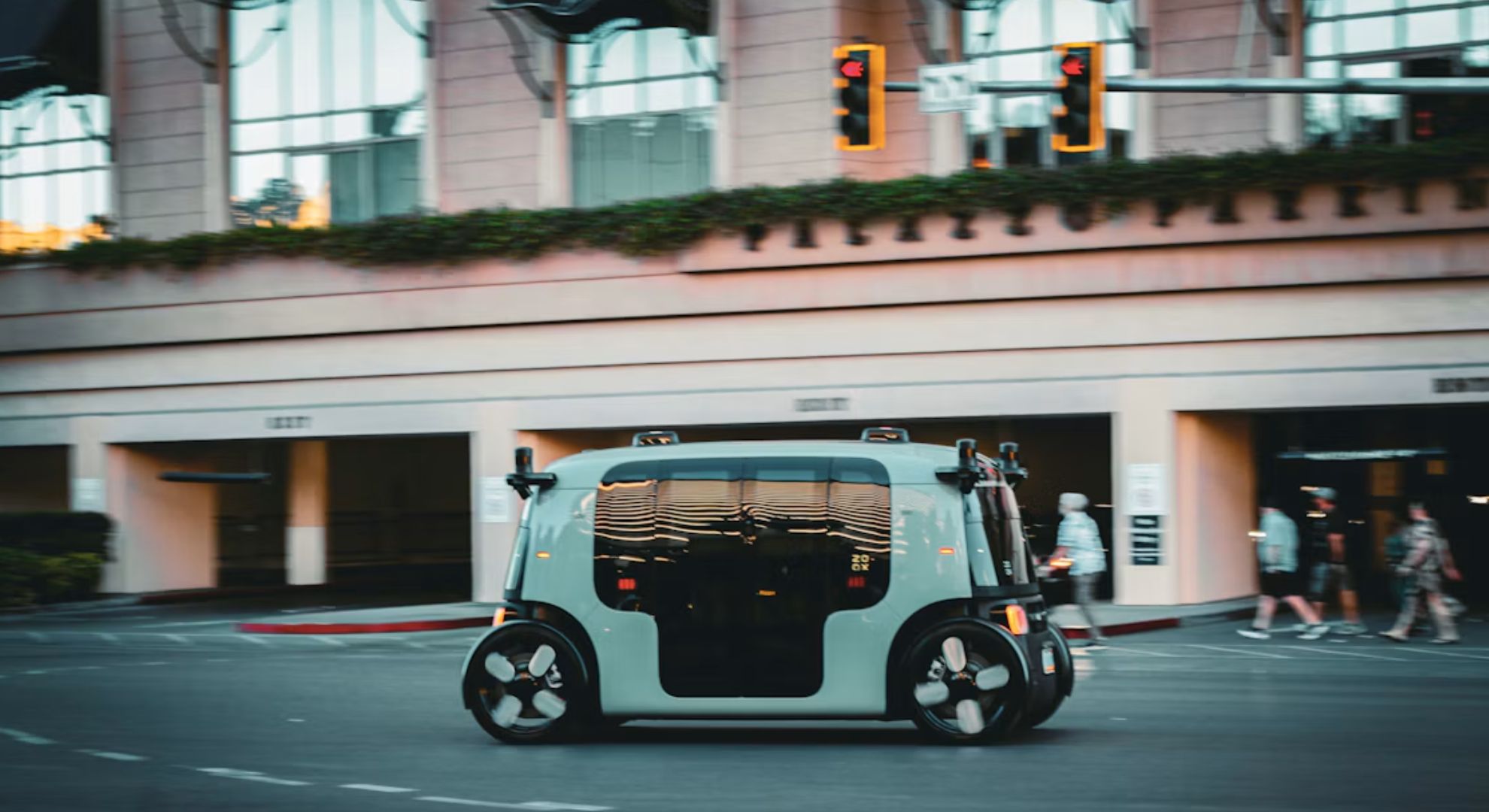
Robotaxis are where the self-driving story gets real. Here's the state of play:
- The Automated Vehicles Act is due for full rollout in 2027, putting a legal framework around self-driving vehicles on British roads.
- Robotaxis have already reached the point where no human driver is needed inside a mapped area, known in the industry as Level 4.
- A trial commenced in London in September 2026, run by Uber and Wayve with TfL-licensed safety drivers on board while the tech earns its stripes.
- Fittingly, London is also home to the Knowledge, one of the most detailed taxi tests in the world, where human drivers memorise 25,000-plus streets.
- Wayve has been training its AI on those same streets since 2018. Now it's up to the robotaxis to master the Knowledge, an ideal real-world test case for autonomous driving!
- Build costs for robotaxis are falling fast too. Baidu's sixth-generation robotaxi now costs under 220,000 yuan (approx. £25,000) to build, down from around 480,000 yuan (approx. £54,000) in 2021. The company says its next generation could come in under 150,000 yuan (approx. £17,000).
Self-driving that works everywhere, in every condition, is still a multi-decade goal. Our driverless cars guide explains how it will work in practice, and what it means for UK drivers and commuters.
AI driver monitoring and safety
Some of AI's best work is focused on the driver, not the driving.
Driver monitoring systems warn drivers who are drowsy or distracted. A drowsiness warning typically picks up changes in steering and lane position that suggest a driver is getting sleepy. A distraction warning usually uses a camera and AI to track where the driver is looking and flags a driver who looks away from the road for too long.
- EU law has required drowsiness warnings in newly approved models since July 2022, and in almost all new cars since July 2024.
- It has required distraction warnings in newly approved models since July 2024, and in almost all new cars since July 2026.
- These requirements apply in Northern Ireland under post-Brexit rules, but not in Great Britain. The government confirmed in July 2026 that it plans to introduce rules requiring both warnings in Great Britain too.
AI-enhanced breathalyser checks
- AI also turns up in a much less glamorous piece of kit: the ignition interlock, the in-car breathalyser already fitted as a legal condition for repeat drink-drive offenders in countries like New Zealand, Canada, and across most of Europe and the US.
- The breath test itself isn't AI, it's a straightforward chemical sensor, checking against the UK's legal drink-drive limit. Where AI comes in is the camera-based check some newer interlocks use during 'rolling retests' on the move, confirming the person blowing into the device is the registered driver, not someone else doing it on their behalf.
- International evidence shows these devices can reduce reoffending rates by up to 70%, but it's not yet law here in the UK.
- A coalition of police chiefs and road safety organisations is pushing the government to make alcohol interlocks, sometimes called 'alcolocks', compulsory for repeat and high-risk drink-drive offenders, but as of September 2026, UK courts still have no power to order one.

AI in speed cameras and number plate recognition
Richard Evans, webuyanycar's head of technical services said:
"ANPR has been reading UK plates for years, matching what a camera sees against a database. It's checking, not thinking, so despite the name, it isn't really AI.
"However, the newer generation of enforcement camera is different. Using computer vision, these judge behaviour, not just plates, spotting a driver holding a phone or missing a seatbelt across multiple lanes at once, with any flagged image reviewed by a person before action is taken.
"Trialled and adopted by UK police forces and backed by National Highways, what started as a single camera has expanded to at least ten forces, and some are now moving toward live enforcement, where flagged offences could result in fines, penalty points or both."
"The stakes are real. According to THINK!, you're four times more likely to crash using your phone while driving, and twice as likely to die without a seatbelt. Speed is only one part of staying safe. Don't forget: put your phone away and seatbelt on before you start the engine, every time."
How AI enhances the in-car experience
AI assistants in the car
Earlier voice assistants required drivers to say fixed phrases, which sometimes had to be repeated before they were recognised.
Luckily, modern equivalents are built on generative AI technology that can produce natural, human-like responses instead of matching a script. These AI-powered assistants can hold something closer to a real conversation, understand oddly-phrased requests, and handle multi-step tasks, such as finding a restaurant, and then checking its menu, in one go.
- Mercedes-Benz's 'Hey Mercedes' assistant now runs on Google Gemini, the first production use of Google Cloud's Automotive AI Agent for in-car conversation.
- BMW's new Intelligent Personal Assistant, built on Amazon's Alexa+ technology, is launching in Neue Klasse models like the iX3, built for natural conversation. The car itself has already reached UK roads, but the assistant is launching first in Germany and the US, with the UK and other markets to follow.
A cure for ageing? Software updates keep older cars feeling new!
Software updates are extending the life of cars already on the road, not just improving new ones. Manufacturers can now send updates remotely, improving performance and adding features to cars their owners bought years earlier.
Some of those updates now bring AI features to older cars too, such as voice assistants that understand natural conversation rather than set commands. Previously, getting features like these would have meant trading in for a newer model.
- Tesla: Over-the-air updates have added Sentry Mode, which turns the car's cameras into a security system while it's parked, and Dog Mode, which keeps pets at a comfortable temperature, with a message on the screen so passers-by know they're fine.
- Polestar: UK owners of the Polestar 2 Long Range Dual Motor can buy a performance upgrade that adds 67bhp over the air.
- Volkswagen: In 2022, existing ID.3 and ID.4 owners received a free over-the-air update that improved charging speeds on 77kWh models and made driving more efficient, particularly in cold weather. It also upgraded Travel Assist, which uses anonymised data from other vehicles.
- Volkswagen Group: A later cloud update added ChatGPT to the IDA voice assistant in UK English, including for some older models. Drivers of selected Volkswagen, Cupra, Seat, and Skoda models can now ask questions in natural language.
Richard Evans, Head of Technical Services at webuyanycar, said:
"A car you bought five years ago can genuinely get better overnight through a software update. Not so long ago, that would have sounded like science fiction. Today it's a part of modern car ownership, and one of the most underrated ways AI and technology are changing car ownership.
"Cars that receive regular updates can gain new features, run more efficiently, and even become safer. Increasingly, many of those updates are bringing AI into older cars too, such as voice assistants you can talk to naturally, rather than learning set commands. That matters when it's time to sell your car. A used car that's still supported with updates can feel closer to a newer model, which can help support a stronger valuation.
"On the other hand, when a manufacturer stops supporting a model, or the connectivity behind its features is switched off, that can weigh on what it's worth. For buyers, it's worth gauging how long a specific model may keep receiving updates before committing."
AI personalisation and predictive maintenance
In-car AI can even adjust seats and mirrors automatically for whoever's driving and learn your regular routes.
It can even continuously monitor things like engine performance, tyre pressure, and brake wear to flag a likely fault before it causes a breakdown, rather than waiting for the next service interval.
Time for a change? Sell your car in under an hour with webuyanycar
Technology moves fast. So do we!
Whether you want to upgrade to a model with the latest AI capabilities or just something more reliable, selling to webuyanycar can help you raise the cash required, with a guaranteed sale. Here's how it works:
- Enter your reg and mileage into our free car valuation tool.
- Book your appointment at any of our 550 UK branches.
- Drive to your appointment. Happy to sell? We'll send the cash to your bank.
- We settle outstanding finance, allowing you to negotiate the next sale with a clean slate. Need to get paid fast? Select our Immediate Payment option to get paid within 15 minutes. (Fees apply.)

AI in car insurance
- Insurers now use AI to interpret telematics data, the black box that tracks braking, cornering, and the time of day, building a more detailed risk profile than age and postcode alone.
- Drivers aged 17 to 20 with a telematics policy save an average of £379 a year compared with standard cover, and 78% of that age group get cheaper insurance this way, according to Association of British Insurers (ABI) data.
- New telematics drivers see a near 50% reduction in collision claims by the end of their first year, against around 30% for standard cover, according to Aviva.
- The same technology speeds up claims. Tractable, the computer vision firm behind Aviva's damage-assessment AI, has reported cutting manual assessment time from 15 to 30 minutes down to under a minute for clients using its technology.
- Separately, Aviva's own AI-driven claims transformation cut the time needed to assess liability on complex claims by 23 days and helped cut customer complaints by 65%.
FAQs
ALVINN is arguably the earliest working example of machine learning behind the wheel: a neural network tested on Carnegie Mellon University's Navlab vehicle in 1989. Unlike earlier automated vehicles running pre-programmed rules, ALVINN learned to steer from road images rather than being told the rules directly.
AI handles quality inspection on the factory floor, with computer vision checking panels and welds faster and more consistently than a manual check, and predictive maintenance technology flags machinery likely to fail before it causes a stoppage.
Agentic AI carries out a short sequence of steps on a driver's behalf without needing an instruction at each stage, rather than just answering one question, like noticing a service is due, checking the calendar, and suggesting a slot.