The Future of Selling Your Car: webuyanycar at 50 million customers
As we passed our 5 millionth customer, we imagined where the journey to 50 million might take us. Step into a world of 30-millisecond payments and robotaxis on the school run, a fact-rooted look at the future of selling your car.
Get a free valuation
Foreword by Richard Evans, webuyanycar's Head of Technical Services
“As we reached our 5 millionth customer, we couldn't help noticing how innovation has already transformed almost everything else around us. Banking apps have made managing money easier for millions of us, our favourite AI app helps us navigate a tricky decision and saves hours of research, and robot vacuums that once needed constant guidance now map, clean, and empty themselves.”
“The same is quietly true of our own industry. Fast-charging batteries and early self-driving cars are only part of the story; imagine roads that charge your car as you drive over them, doing away with plugging in altogether, or a flying taxi hopping between cities. We've already glimpsed the future and some of it is closer than you might think.”
“We wanted to explore what might happen if the trends currently shaping the industry kept going, and whether this technology boom could expedite our journey from 5 to 50 million customers! We hope it's as much fun to read as it was to imagine!”
Imagining the car of the future
How it's powered
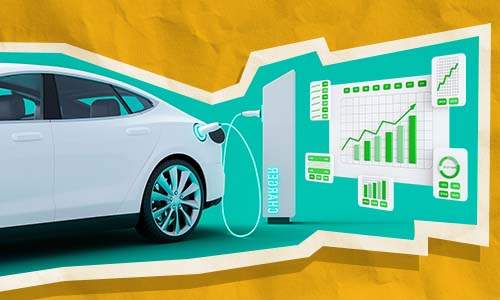
EVs are on track to become a leading powertrain, driven by the ZEV mandate target requiring all new cars sold to be fully electric by 2035, backed by continued rollout of public EV chargepoints.
- EV uptake is currently behind target, but a large share of new sales going electric by 2035 remains the likely outcome.
- The mandate winds down new petrol, diesel, and hybrid sales between 2030 and 2035; used examples are set to remain in circulation.
- As the new car market tilts towards EVs, the wider car parc should follow a few years behind.
Batteries stop being a conversation. Solid-state batteries could replace the liquid inside a normal EV battery with a solid material, promising faster charging and greater range from a smaller, lighter pack.
- Toyota: production car by 2027/2028, starting with a flagship model.
- Nissan and Volkswagen: both manufacturers have their own versions in the works.
- By 2035, 'range anxiety' could be a phrase only older relatives remember, a shift already showing up in robotaxis, where roughly 86% worldwide are already fully electric, since high-mileage fleet use suits an electric drivetrain better than the average private car does.
How it's driven
We imagine most cars will still be human controlled, with varying degrees of driver assistance, but a smaller, growing share will be genuinely autonomous, with no hands on the wheel at all. That shift is already under way:
Waymo opens the world's first fully driverless public robotaxi service, in Chandler, Arizona.
San Francisco follows.
14 US cities, around 500,000 paid rides a week. On 3 September, Uber and British firm Wayve launch the UK's first supervised autonomous rides in London, 140,000+ Londoners already signed up, a smaller, safety-driver-supervised step: a real signal of where things are heading here, too.
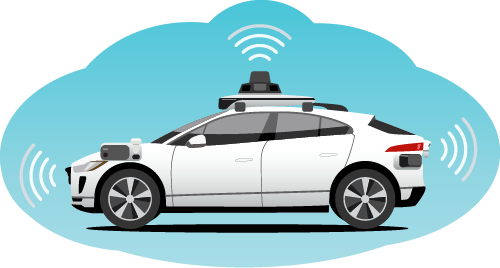
Autonomous driving levels explained
No Driving Automation. You're doing the driving, at most a warning or emergency brake assist.
Driver Assistance. Basic help like cruise control, but steering and watching the road is still required.
Partial Driving Automation. Steers, accelerates, and brakes together, but you must keep watching the road. Most current 'autopilot' systems sit here.
Conditional Driving Automation. Drives itself in the right conditions, but you must stay ready to take back control at short notice.
High Driving Automation. Handles everything within its operating area, no input needed, though a supervisor may still ride along while the tech proves itself, as with Wayve and Uber's London taxis.
Full Driving Automation. No human needed, anywhere, with unrestricted autonomous driving, in all conditions. Not yet achieved anywhere in the world.
The road to autonomous driving
By 2036, we imagine a small, early-adopter population of privately owned Level 4 cars on UK roads, geofenced to a regular route rather than free-roaming anywhere on Earth. In as little as a decade, customers could be selling autonomous private cars and robotaxis at webuyanycar branches.
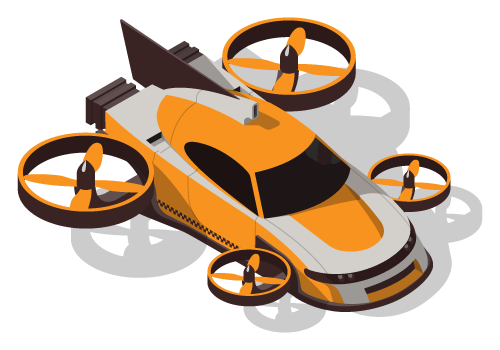
How far can it go? Flying taxis?
- Piloted, fixed routes: The UK government's aiming for a regulatory framework by 2028, with Vertical Aerospace's aircraft due for certification in 2029, already delayed three times, but that still leaves plenty of runway for this to arrive before 2036.
- Fully autonomous, no pilot: Further out, no firm date yet, but the piloted version (similar to London's Wayve/Uber trial) already feels achievable within the decade.
The future of selling your car
In the near future, your webuyanycar appointment could feel like a doctor retrieving your medical notes from a database. Hand over your keys, and your car's whole backstory appears in a flash.
The idea: a diagnostic chip, fitted as standard, holding a car's full condition and history. No human inspection needed, making it quicker and easier to sell your car:
- No forms.
- No digging through old service records.
- Just a report and a price, in 30 milliseconds.
Richard Evans, webuyanycar's Head of Technical Services, says:
“You might think we've invented something out of nowhere, but look at what's already out there. Brego, a UK firm, already returns valuations in under 50 milliseconds for finance and insurance providers.”
“Telematics already makes valuations sharper too, used in nearly half of new tools, improving accuracy by up to a fifth, though the data mostly stays locked behind manufacturer permission.”
“Even paperwork's catching up; a digital driving licence is being piloted, with every government service required to offer some kind of digital alternative by 2027.”
“Put those together, and the chip isn't really a leap. It's just what happens when someone finally puts them in the same room.”
Setting the pace for the future of car selling
Today: An appointment time under 25 minutes, 11 drive to branch.
Tomorrow: A 3-minute appointment, 6-minute drive, valuation and payment in under 30 milliseconds.
Private sales and dealer platforms may not speed up the same way, the usual roadblocks of finding a buyer could remain.
Thinking about selling your car? There's no time like the present!
Value your time? With webuyanycar, you don't need to wait for tomorrow. For a fast, hassle-free way to sell:
- Enter your reg and mileage into our free car valuation tool to get a quote in under 30 seconds.
- Book your appointment at any of our 550 branches.
- Sell your car in under an hour, no chip required!
Postcard from 2036: A time traveller's car selling story
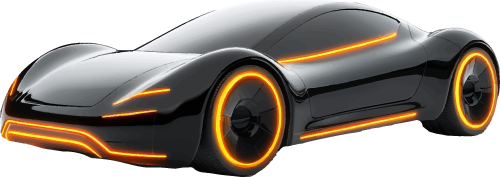
The Eon 500 Timecar was the first ever mass-market time machine and created quite a buzz when it first landed in 2132.
At launch, it was way out of my price range, but after a few years and some careful budgeting, I was finally able to buy a used first-gen example. Sure, the upholstery was a bit worn, and the cabin got a little noisy during time travel (they ironed this out by gen 2), but it was all mine!
Nothing compared to finally joining the ranks of the world's time explorers and witnessing history's defining moments up close. With 11 million miles on the clock, my Eon 500 has seen plenty: woolly mammoths, ancient civilisations, utopian cities, and technologies that are hard to describe with words.
However, as much as I loved the Eon, it was starting to show its age. Nothing crazy, the suspension was a little creaky and the timeline stabiliser warning light that was fixed at the last service had reappeared. Plus, I've just moved to the big city for a new job and sadly don't have much time for this hobby nowadays.
I decided to combine selling the Eon with one last trip to the 2036 Oasis Farewell Tour. After the gig, I parked it at the webuyanycar pod next to the venue and explained everything to the buyer. Before I knew it, the chip had read the full service history, logged and tamper-proof across every timeline I've ever visited.
A quick but thorough diagnosis flagged nothing worse than the timeline stabiliser fault I'd already clocked myself. A price appeared on my phone. Looked good to me! The documents sync themselves, and the payment clears in a flash. I requested a TimeCab and I was back home in the 22nd century in a jiffy.
Whether you're selling an Eon 500, a Rolls-Royce, or a Ford Focus, I can't recommend webuyanycar enough!
Cal Year (Retired Time Traveller)