


How to Estimate Your Car's Trade-in Value Without Using Online Valuation Tools
Published June 19, 2026
Knowing what your motor is worth before you trade it in puts you in control. You can spot a fair offer, push back on a low one - and avoid leaving money on the table.
For many drivers, submitting a few simple details into webuyanycar’s car valuation tool can return a helpful figure within 30 seconds.
However, understanding the variables behind that number, how age, mileage, documentation, condition - and other valuation factors come into play, will give you a sharper basis for judging any offer you receive.
By the end of this guide, you will know exactly how manual trade-in estimation works, what each step involves - and how they compare to online valuation tools.
Get a free valuation
What is a manual trade-in valuation estimation?
A manual trade-in estimation calculates an approximate offer price for your motor without a live digital tool. Instead of an algorithm drawing on real-time market transactions, you work through a series of structured adjustments yourself, starting from the vehicle's original retail price and reducing it for age, mileage, condition and documentation.
The result is a ballpark figure, not a market-accurate price. These methods are useful for building awareness before approaching a dealer, but they carry limitations worth understanding before relying on them for any firm decisions.
What are the traditional estimation methods?
Three approaches were in use before live-market tools became standard:
Fixed depreciation tracking: Calculating value loss against industry-standard depreciation milestones.
Classified market comparisons: Looking up comparable makes, models, specifications and mileages on online used car platforms to establish a price range based on what similar vehicles are actually listed for.
Physical degradation auditing: Assessing visible damage, mechanical wear, tyre condition, and service history gaps, then estimating the financial impact of each as a deduction from the baseline figure.
All three methods can be used independently or in conjunction. Together, they produce a more comprehensive result, but all are time-consuming - and still rarely match the accuracy of an online car valuation tool pulling live market data.
How to estimate trade-in value without online tools
The following process draws all three traditional methods into a step-by-step guide you can work through before approaching a car dealer:
Step 1: Find your vehicle's original retail price
Look up the manufacturer's recommended retail price (RRP) for your exact make, model, trim, and engine when new.
If you bought the car new, use the price you paid. If you bought it used, trace the original new price through an online car selling platform, or the manufacturer's website.
This figure is your starting point, not your trade-in value. The methods below show you how to adjust it for age, mileage, and condition to arrive at a realistic estimate.
Step 2: Apply age-based depreciation
Reduce your base price using webuyanycar market data as your benchmark. Our May 2026 dataset shows that on average, petrol, and diesel cars typically retain around 70% to 73% of their value after the first year, meaning a loss of roughly 27% to 30% in year one.
By year three, many have lost between 40% and 50% of their original retail price. Electric cars typically depreciate faster: the average EV retains around 57% of its value after one year and approximately 38% by year three. Apply the rate that matches your fuel type - and adjust your base price accordingly. 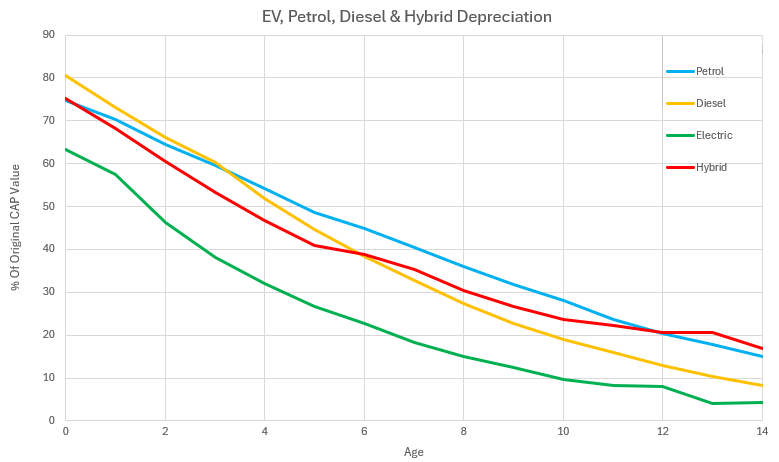
Step 3: Compare your mileage against the UK average
According to the Department for Transport's National Travel Survey (August 2025), the average UK car covers around 7,100 miles per year. Use this as your benchmark when assessing your own mileage position.
- Above average mileage: apply a downward adjustment to account for additional wear on key components such as the engine, transmission and brakes.
- Below average mileage: a modest upward adjustment may be appropriate; low mileage is a positive signal to buyers and dealers alike.
- Significantly above or below: the greater the deviation from 7,100 miles per year, the larger the value adjustment.
Step 4: Assess your documentation
Missing items reduce trade in value. Replacing them before selling often costs less than the deduction a dealer will apply.
- V5C logbook: The official DVLA record of the vehicle's registered keeper, used to transfer ownership at point of sale. Without it, the process becomes more complicated, many buyers will not proceed, and webuyanycar will not purchase the vehicle. Can be replaced via GOV.UK for £25.
- Service history: A significant documentation factor, particularly on newer and higher-value cars where buyers and dealers expect a verifiable maintenance record. Its absence matters less on older, lower-value vehicles. Service records may be a stamped booklet, dealer printouts or a digital history held by the manufacturer or servicing network. If records are incomplete, contact previous garages as many can retrieve historical invoices.
- Keys: A missing second key attracts a deduction. Both keys missing makes the car very difficult to sell. Car key replacement costs vary but are often lower than the dealer deduction, so it is worth getting a quote first.
- Wheel locking nut key: Often leads to deductions but is cheap to replace. Source one before selling your car.
- Handbooks and accessories: Original handbooks, parcel shelves, and any manufacturer-supplied accessories. Small individual deductions that add up.
Step 5: Account for physical condition
Inspect the vehicle and note any bodywork damage, interior wear, tyre condition, and known mechanical issues. Dealers factor in the cost of reconditioning before putting a car back on the forecourt - and any repair work they need to commission will be deducted from their offer.
Before investing in professional detailing, scratch repairs or minor mechanical fixes, weigh the cost against the likely improvement to your offer. Not every repair will pay for itself, but a clean, well-presented car will always be easier to sell.
Step 6: Factor in dealer overheads and margin
A dealer's part-exchange offer reflects the trade price, not the retail value of your motor. Reconditioning costs, storage, overheads, and profit margins all reduce the figure before you see it. Trade-in offers are structurally lower than the retail price the same vehicle would achieve when resold, and this applies regardless of condition.
Which factors affect trade-in value?
| Factor | What to assess | Effect on value |
|---|---|---|
| Age | Year of registration and original RRP | Major: petrol and diesel cars lose around 40% of retail value by year three; EVs lose around 62% |
| Mileage | Annual average vs the 7,100-mile UK benchmark | Significant: above-average mileage reduces offer; below-average can support a premium |
| Documents and accessories | V5C logbook, service history, keys and accessories | Significant: incomplete records and missing items reduce trade price, particularly on newer and higher-value cars. Missing items are often worth replacing before sale. |
| Physical condition | Bodywork, interior, tyres, mechanics | Variable: all damage and wear factored in as reconditioning cost by the buyer |
| Market demand | SMMT registration data and automotive trade press give a broad picture, but regional and seasonal shifts require live data to reflect accurately. | A high-demand model in short supply can command a stronger price. Falling popularity or oversupply can reduce value quickly regardless of condition. Neither effect can be captured reliably by manual estimation. |
How do manual estimates compare to online valuation tools?
Manual estimation gives you a useful educational baseline but falls short of a live digital valuation in several important respects:
| Evaluation factor | Manual estimation | Online valuation tool |
|---|---|---|
| Processing speed | Several hours of research and calculation. | Get a quote within 30 seconds with webuyanycar. |
| Data source | Historical averages and personal research. | Real-time UK market transaction data. |
| Market demand | Cannot account for seasonal trends or regional demand. | Adjusts automatically to current conditions. |
| Model accuracy | Relies on broad averages unless researched in depth. | Accounts for specific make, model, spec and trim. |
| Susceptibility to error | Prone to bias and miscalculation at each step. | Objective output based on declared inputs. |
To get a figure you can act on, one that reflects what your specific car is worth in the current UK market, a live valuation tool is the more practical option.
Curious about what your motor could be worth? Enter your reg plate and mileage into our free car valuation tool. To ensure a comprehensive valuation, we recommend providing as much detail as possible about your car’s condition and history.
Frequently asked questions
This simply means estimating your car's value manually rather than through a live digital tool.
You work from the vehicle's original retail price, apply age-based depreciation benchmarks, research comparable listings to establish a market reference, and make deductions for mileage, condition, and missing documentation.
The result may reflect general industry averages rather than real-time market data, so treat it as a rough guide rather than a figure you can negotiate from.
No, manual estimation relies on broad averages and subjective condition judgements, both of which introduce scope for error.
It cannot track live changes in supply and demand, account for seasonal pricing shifts or reflect the specific residual value performance of individual makes and models.
Conversely, online tools drawing on real-time transaction data can provide considerably more accurate results.
The fastest way is to use a free online valuation tool. With webuyanycar, you can declare your motor's condition, including bodywork damage, mechanical issues, and write-off history, and receive a valuation that reflects those inputs directly.
If you want to understand costs before deciding whether to repair or sell, it's worth getting quotes from reputable bodywork specialists/mechanics. Knowing what any work would cost gives you a clearer picture of where you stand financially either way.
Usually because manual estimates start too high. Many drivers use retail price comparisons as their reference point, but dealer trade-in offers reflect the trade price of a vehicle, which is lower by design.
Before arriving at a figure, dealers account for factors such as reconditioning, storage, overheads and profit margins. That gap exists in every part-exchange transaction and is not specific to the condition or desirability of any individual car.