



Driving in a heatwave
Heatwaves are becoming a regular part of UK summers, and they bring a specific set of risks for drivers that are easy to overlook.
A parked car heats up faster than you might think. Research from Stanford University found that the temperature inside a parked car rises fastest in the first 30 minutes in the sun, with the interior reaching a scorching 47°C within an hour, even on a mild 22°C day.
Hot weather doesn't just make your car uncomfortable. It puts extra strain on tyres, engines, and batteries, can soften road surfaces, and even affects what's safe to leave inside your car.
Here's what drivers need to know to stay safe on the road this summer.
Get a free valuation
How to prepare for driving in a heatwave
A few quick checks before you set off, and packing essential kit when the forecast is looking hot, can make a real difference to your comfort and safety.
Before you travel
- Check tyre condition and pressure, along with coolant, oil and screenwash levels.
- Check the air conditioning is working.
- Watch for signs of overheating, especially in older vehicles, such as a rising temperature gauge or steam from under the bonnet.
- Keep the windscreen clean, since glare from bright sun can affect visibility.
- Check the forecast and avoid travelling during the hottest part of the day where possible.
- Allow extra time for journeys.
- Wear appropriate footwear. Flip-flops and loose sandals can slip off or get caught under the pedals.
- Make sure you're properly rested before a long drive.
- Be aware that some hay fever medication can cause drowsiness.
Pack a heatwave kit
- Ample water for all passengers and pets
- Snacks that won't spoil in the heat, such as granola or energy bars rather than chocolate, which can melt
- A fully charged phone and a power bank as backup
- Sunglasses and a hat
- Sun cream
- A windscreen sunshade
- Any emergency medication you may need
Cooling the car down quickly
A hot car can feel unbearable within minutes of parking in the sun, but a few quick techniques can help you cool down fast once you're moving.
To quickly cool a hot car, wind a rear window fully down on the opposite side to the front door you're using. Swing that door open and closed briskly a few times before switching on the air conditioning. This pushes hot air out through the open window and pulls in cooler air from outside, and works best with the window fully open. The technique was popularised by a viral video from Cambridge mathematician and broadcaster Professor Hannah Fry.
As you set off, open the windows and point the air vents down at your feet, with the air conditioning switched on. Cool air sinks, so this pushes the hot air up and out through the open windows. Once the interior feels noticeably cooler, close the windows and switch the vents back to face level. Use recirculation to keep that cooled air in, but switch back to fresh air on longer drives so the interior doesn't start to feel stuffy.
Not every car has working air conditioning, so here are some smart tips to keep things cool without it:
- Park in the shade or angle the windscreen away from the sun: This helps stop the interior heating up in the first place. Sunlight passing through the glass heats surfaces like the dashboard and seats.
- Use a windscreen sunshade: These cover the inside of the windscreen to reflect the sun's rays away before they reach the interior, keeping touchpoints like the steering wheel and gear stick cooler.
- Cover the seats with a blanket or light-coloured seat covers: Dark and leather seats absorb more heat and can get uncomfortably hot. Leather can also crack over time if it's regularly exposed to strong sun.
- Wipe down hot surfaces with a damp cloth: Focus on areas such as the door handles, gear stick and handbrake.
- Place towels over the seats: This can help keep you and any passengers cooler.
- Leave the windows open by a couple of centimetres: This allows hot air, which naturally rises and collects near the roof, to escape gradually rather than building up. Keep the gap small to avoid creating an easy opportunity for would-be car thieves.
Before anything else, it is worth pausing on one of the most serious risks a heatwave poses, one that has nothing to do with the car itself.
Dogs in hot cars
Dogs are at serious risk if left in a parked car during hot weather, even for a short time.
Cracking the windows makes little difference, as the Stanford research mentioned earlier found. On a 22°C day, the study found a car's interior can reach around 47°C within an hour, which, according to the RSPCA, can be fatal for a dog.
If a dog in a car shows signs of heatstroke:
- Call 999 immediately.
Breaking the window falls into a legal grey area and could be treated as criminal damage. Under the Criminal Damage Act 1971, you have a legal defence if you honestly believed the owner would have consented, given the danger to the dog. Telling the police your intentions, taking photos as evidence and gathering witnesses beforehand can help support that.
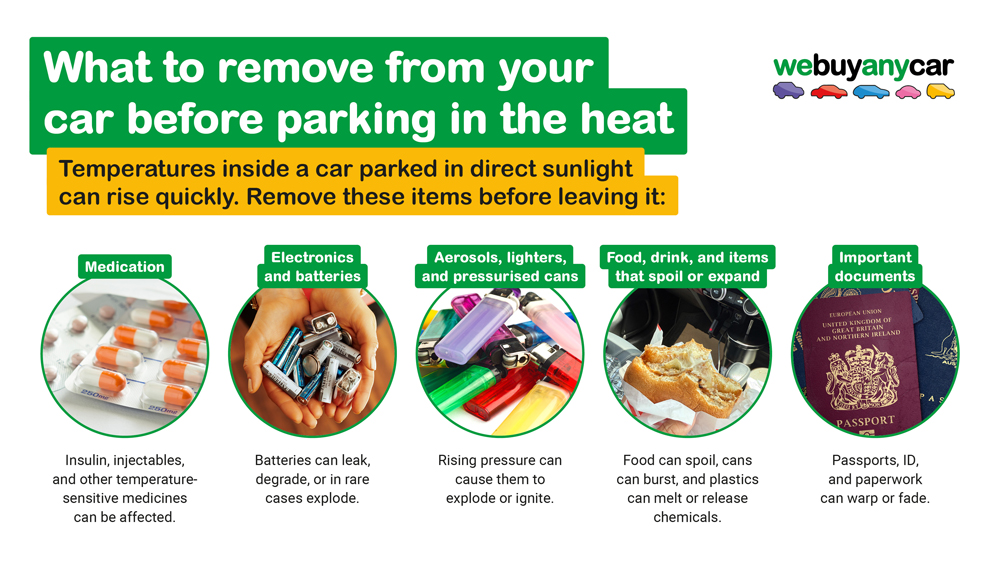
What to remove from your car before parking in the heat
Dogs arguably face the most serious risk from a hot car, but there's more to consider: many everyday items are easily damaged or become dangerous in the heat.
If you park your car in direct sunlight during hot weather, the interior can quickly climb well past the temperature outside. Make sure you remove the following before parking in the heat:
Medication
Some medicines need to be stored below 25°C or in the fridge, following the storage instructions on the packaging. Many medications, including insulin and other injectable treatments, are sensitive to heat, so check the official guidance to confirm how to store them safely.
If you need to travel with heat-sensitive medication, keep it with you rather than leaving it in a parked car, ideally in an insulated cool bag or cool box, to stop it getting too hot. Always follow the manufacturer’s storage guidance.
Electronics and batteries
Phones, sat navs, power banks and vapes all contain lithium-ion batteries that are highly sensitive to heat. Increased temperatures can cause them to leak, degrade or, in rare cases, explode.
Dash cams commonly use lithium-ion batteries too and carry the same risk, especially when wedged between the windscreen and a sunshade, where heat can concentrate well above the surrounding interior temperature.
Some premium models use a supercapacitor instead, which is less prone to heat damage, though it's still sensible to avoid leaving any dash cam in direct, sustained heat where possible.
You should also refrain from leaving disposable batteries in your car, as heat can make the acid inside prone to leaking, which can burn upholstery if left on a seat.
Aerosols, lighters and pressurised cans
Aerosol cans for products such as deodorant, hairspray and sunscreen are sealed under pressure. This pressure can build up and cause the can to explode in high temperatures.
Disposable lighters carry a similar risk, as heat can expand the gas inside and cause it to ignite. Always check the storage temperature warning on aerosols and avoid leaving lighters on the dashboard or in direct sunlight.
Food, drink and anything else that spoils or expands
Heat can increase the pressure inside canned carbonated drinks, causing them to burst. Plastic water bottles can also release chemicals into the water as they heat up, so it's worth taking bottled water with you or switching to a reusable metal or glass bottle.
Plastics more broadly can melt or release harmful chemicals in extreme temperatures.
Important documents
Passports, other ID documents and paperwork can warp or fade in a hot car. Leaving important documents in your vehicle also raises the risk of theft or identity fraud, so take them with you whenever possible.
A few other easy-to-miss items
- Sunglasses, which can warp or discolour if left on the dashboard in direct sun
- Makeup, particularly lipstick, which can melt and stain the car's interior
- Hand sanitiser, which often contains flammable alcohol
- Pens, which can burst and leak ink that's difficult to clean up
- Glasses with curved lenses, including prescription glasses and sunglasses, which can occasionally concentrate sunlight like a magnifying glass and pose a small fire risk
What to do if your car overheats
Keeping the inside of your car cool is one thing, but heat can also put your engine itself at risk. If your car overheats, pull over as soon as it's safe.
The engine temperature warning light is usually red when the engine is overheating, since it needs immediate attention. It can appear for several reasons, including a broken thermostat, a failing water pump, a fault with the cooling fan and coolant that's dropped low enough to let the engine overheat.
Continuing to drive when this warning light is red risks costly, sometimes irreparable engine damage. If the red light appears, the temperature gauge moves into the red or steam appears from the engine bay:
- Pull over once safe and switch off the engine.
- Open the bonnet to help the engine cool, but never remove the coolant cap while it's hot. The pressurised system can cause steam burns.
- Once cooled, check the coolant level and top it up if needed.
- If the problem persists, call your breakdown provider rather than continuing to drive.
How heatwaves affect roads
It's not just what's under the bonnet that heat affects; the road surface itself can be a hazard too. Prolonged heat softens road surfaces, especially older or more vulnerable ones, and this is a genuine UK phenomenon, not just a hazard for hotter countries.
For example, Devon has seen this first-hand on more than one occasion: road surfaces reached as high as 60°C during a 2018 heatwave and 56.2°C during the record-breaking 2022 heatwave.
Roads can begin to soften when surface temperatures near 50°C. Air temperatures in the low-to-mid 30s can push road-surface temperatures much higher because dark asphalt absorbs and stores heat.
Roads won't melt outright. The real danger is localised: soft, uneven patches that can compromise grip and make braking or steering less predictable.
If you hit a softened or damaged surface:
- Slow down.
- Avoid harsh braking or steering.
- Keep more distance from the vehicle in front.
Quick heatwave checklist
-
Check tyres, coolant, oil and air conditioning before setting off.
-
Remove high-risk items before parking in the sunlight.
-
Never leave a child, vulnerable passenger or pet in a parked car, even briefly.
-
Use the ‘door fan’ trick to cool the interior quickly.
-
Park in the shade where possible and use a windscreen shade.
-
Watch for softened road surfaces and allow extra time when travelling.
Frequently Asked Questions
Any heat is a risk. Dogs can't cool down as effectively as humans since they only sweat through their paws, so heatstroke can set in fast, even on an overcast day.
Arguably the fastest method is to open the windows on one side, then swing the opposite door back and forth several times to pump hot air out (the same trick demonstrated in Hannah Fry's viral video).
Parking in the shade and using a windscreen shade can help prevent the heat building up in the first place.