


UK car tax bands 2026/27: How much will you pay?
Car tax, also known as road tax or Vehicle Excise Duty (VED), is an annual cost most UK drivers must pay to keep a vehicle on the road.
The amount you pay depends on when your car was first registered, its CO₂ emissions, fuel type, and in some cases, its original list price. Car tax rates are typically updated each April, usually in line with inflation.
The latest 2026/27 car tax tables came into effect on 1 April 2026 and are now available on the DVLA website. If you're unsure how these changes affect your car, we've got you covered.
Our updated car tax guide breaks down the 2026/27 rates in a clear, comprehensive way, so you can quickly understand how much you'll pay in car tax.
Whether you're buying a new car, planning your budget, or checking how changes affect your current vehicle, the tables and examples below are designed to make the system easier to navigate and help you budget for motoring costs more effectively.
Unsure when your current car tax expires? Use our free car tax check tool to instantly check.
Get a free valuation
What changed for car tax in April 2026?
Numerous changes to the UK’s car tax system took effect on April 1 2026:
Standard road tax rate increase
The standard annual road tax rate for most cars registered from 1 April 2017 onwards has increased from £195 to £200 per year.
This flat rate typically applies from the second year after a car is first registered.
Electric vehicles remain within the standard car tax system
Electric vehicles were previously exempt from paying car tax. However, from 1 April 2025 (when the 2025/26 tax year began), EVs became subject to road tax for the first time.
Under the current rules, most EVs now pay:
- £10 in the first year of registration (showroom tax).
- The standard rate from the second year onwards.
For 2026/27, the standard rate is £200 per year, aligning EV taxation with petrol and diesel vehicles registered from April 2017.
Expensive Car Supplement changes
The following changes were applied on 1 April 2026:
- The Expensive Car Supplement (ECS), an additional annual charge for higher-value cars, increased from £425 to £440 per year.
- The ECS threshold for electric vehicles increased from £40,000 to £50,000.
- The ECS threshold for petrol, diesel, and hybrid cars remains at £40,000.
What hasn't changed:
- The supplement still applies for five years, starting from the vehicle's second annual tax payment.
- Any vehicle above the relevant threshold must pay the ECS on top of the standard rate.
ECS and VED costs for 26/27
During the 2026/27 tax year, affected vehicles will typically pay:
- Standard rate: £200
- ECS: £440
- Total: £640 per year
This is likely to change in subsequent tax years when VED bands are adjusted.
EV ECS threshold rising to £50,000
On 1 April 2026, the Expensive Car Supplement (ECS) threshold for fully electric vehicles increased from £40,000 to £50,000.
This means electric cars with a list price above £50,000 will usually be subject to the additional charge.
The change applies to qualifying EVs registered from 1 April 2025. In practice, vehicles priced between £40,000 and £50,000 registered since that date are no longer liable for the supplement from April 2026 onwards.
The £40,000 threshold remains in place for petrol, diesel and hybrid vehicles.
Some EV owners may have paid one year of the supplement under the previous rules if the vehicle was taxed before April 2026.
If you taxed a new EV in 2025/26, you do not need to reapply — the updated threshold is applied automatically when you next tax the vehicle.
New pay-per-mile tax for EVs and PHEVs
In the November 2025 Budget, the Government announced plans to introduce a new mileage-based tax, known as Electric Vehicle Excise Duty (eVED), for electric cars and plug-in hybrids.
The scheme is due to take effect from April 2028, although legislation will be introduced in a future Finance Bill.
Under the current proposal, electric cars would pay a per-mile charge alongside existing Vehicle Excise Duty (VED), based on half the equivalent fuel duty rate of the average petrol or diesel car. Plug-in hybrids would pay 50% of the EV rate. The final rates and structure could still change before implementation.
In early 2026, the Government consulted on how the system would work in practice. That consultation closed in March 2026.
The policy is intended to support a fair transition to electric vehicles as the car tax system adapts to lower fuel duty receipts over time.
For cars registered on or after 1 April 2017
Cars registered on or after 1 April 2017 follow a two-part system:
- A first-year rate based on emissions.
- A standard annual rate from year two onwards.
First-year road tax rates (2026/27)
CO₂ emissions (g/km) |
2026/27 standard first-year tax* |
2026/27 non-RDE2 diesel |
2025/26 standard first-year tax* |
2025/26 non-RDE2 diesel |
|---|---|---|---|---|
| 0 | £10 | £10 | £10 | £10 |
| 1–50 | £115 | £135 | £110 | £130 |
| 51–75 | £135 | £280 | £130 | £270 |
| 76–90 | £280 | £365 | £270 | £350 |
| 91–100 | £365 | £405 | £350 | £390 |
| 101–110 | £405 | £455 | £390 | £440 |
| 111–130 | £455 | £560 | £440 | £540 |
| 131–150 | £560 | £1,410 | £540 | £1,360 |
| 151–170 | £1,410 | £2,270 | £1,360 | £2,190 |
| 171–190 | £2,270 | £3,420 | £2,190 | £3,300 |
| 191–225 | £3,420 | £4,850 | £3,300 | £4,680 |
| 226–255 | £4,850 | £5,690 | £4,680 | £5,490 |
| Over 255 | £5,690 | £5,690 | £5,490 | £5,490 |
*The standard first-year rate applies to petrol cars, most modern diesel cars (those that meet RDE2 emissions standards), hybrids, and electric vehicles.
Diesel cars that don't meet RDE2 standards are charged a higher first-year rate in most bands. The figures shown above are based on official GOV.UK vehicle tax tables for the 2025/26 and 2026/27 tax years.
The first-year showroom tax must be paid upfront. There is no option to spread the cost into monthly or twice-annual payments.
Richard Evans, webuyanycar's Head of Technical Service, said:
"The DVLA's confirmed first-year VED rates for 2026/27 continue to strongly favour low-emission cars, with new EVs attracting just £10 in showroom tax, while models in the highest CO₂ emission band now face up to £5,690.
"The system remains highly progressive, with sharp increases at the top end. Notably, choosing a version of the same car that falls just below the 255g/km threshold could save buyers around £840 in first-year tax alone, highlighting how even small differences in emissions can have a significant cost impact!"
RDE2 standards explained
- Your diesel car must meet Euro 6d emissions standards (RDE2) to avoid a higher first-year tax band.
- RDE2 measures emissions in real driving conditions, not just lab tests.
- Most cars registered from around 2020–2021 onwards meet this standard.
- Older diesels (e.g. Euro 6b or 6c) usually do not meet RDE2.
- You can check your car's standard on the V5C logbook or manufacturer's Certificate of Conformity.
At least 59 cars will face a £5,690 showroom tax in April 2026
The highest first-year VED rate is £5,690, which applies to cars emitting over 255g/km of CO₂.
Around 59 new car models fall into this top band for 2026/27, typically high-emission performance cars, large SUVs and pickups.
Models in the highest car tax band
Manufacturer |
Models |
|---|---|
| Alfa Romeo | Stelvio 2.9 V6 Bi-Turbo |
| Aston Martin | DB12 4.0 V8 · DBX 4.0 V8 · Vantage 4.0 V8 |
| Audi | R8 5.2 FSI V10 · RS6 4.0 TFSI V8 · RS7 4.0 TFSI V8 · RSQ8 4.0 TFSI V8 · S8 4.0 TFSI V8 · SQ7 4.0 TFSI V8 · SQ8 4.0 TFSI V8 |
| Bentley | Bentayga 4.0 V8 · Continental 4.0 V8 · Continental 6.0 W12 · Flying Spur 4.0 V8 |
| BMW | Alpina XB7 4.4 V8 · M8 4.4 V8 · X5 M 4.4 V8 · X6 M 4.4 V8 · X7 M 4.4 V8 |
| Cadillac | Escalade V8 |
| Chevrolet | Corvette Stingray 6.2 V8 |
| Dodge | Challenger V8 · Charger V8 |
| Ferrari | Purosangue 6.5 V12 · Roma 3.8T V8 |
| Ford | Mustang 5.0 V8 · Ranger 2.0 EcoBlue · Ranger 3.0 EcoBlue · Ranger 3.0 V6 |
| GMC | Hummer EV |
| INEOS | Grenadier 3.0P |
| Jaguar | F-PACE SVR |
| Jeep | Wrangler 6.4 V8 |
| Lamborghini | Huracán · Urus |
| Land Rover | Defender V8 · Discovery V8 · Range Rover V8 · Range Rover Sport V8 |
| Lexus | LX 600 |
| Maserati | MC20 · Levante V8 |
| Mercedes-AMG | GT · G63 · SL · S63 |
| Nissan | GT-R |
| Porsche | 911 Turbo · Cayenne Turbo · Panamera Turbo |
| RAM | 1500 V8 |
| Rolls-Royce | Cullinan · Ghost |
| Shelby | GT500 |
| Toyota | Land Cruiser · Tundra |
| Volkswagen | Amarok V6 |
Standard car tax rates (year two onwards)
From the second year of registration onwards, most cars registered from 1 April 2017, including petrol, diesel, hybrid and fully electric models, pay the standard £200 annual rate, with an additional charge for higher-value vehicles.
Scenario |
2026/27 rate |
2025/26 rate |
Notes |
|---|---|---|---|
| Standard rate | £200 | £195 | Applies to most cars from year 2 onwards. |
| Non-EVs with a list price over £40,000 – and EVs priced over £50,000 | £640 | £620 | Includes standard rate + ECS for 5 years after first tax year. |
Payment options (standard rate) only
Payment method |
2026/27 cost |
2025/26 cost |
|---|---|---|
| Annual payment | £200 | £195 |
| 6-month payment | £110 | £107.25 |
| Monthly Direct Debit | £210 total | £204.75 total |
- Annual payment is the cheapest option. (You'll pay the standard rate only.)
- Paying every 6 months costs around 10% more overall than paying annually.
- Paying by Direct Debit (monthly) costs around 5% more than paying upfront.
Cars registered between 1 March 2001 and 31 March 2017
Vehicles registered between 1 March 2001 and 31 March 2017 are taxed based on CO₂ emissions bands (A–M). Rates are set by the DVLA and are typically updated each year in line with inflation.
Band |
CO₂ emissions (g/km) |
2026/27 rate |
2025/26 rate |
|---|---|---|---|
| A | Up to 100 | £20 | £20 |
| B | 101–110 | £20 | £20 |
| C | 111–120 | £35 | £35 |
| D | 121–130 | £170 | £165 |
| E | 131–140 | £200 | £195 |
| F | 141–150 | £225 | £215 |
| G | 151–165 | £275 | £265 |
| H | 166–175 | £325 | £315 |
| I | 176–185 | £360 | £345 |
| J | 186–200 | £410 | £395 |
| K* | 201–225 | £445 | £430 |
| L | 226–255 | £760 | £735 |
| M | Over 255 | £790 | £760 |
Please note: These rates are based on official DVLA vehicle tax tables (V149). Rates are typically reviewed and updated annually, in line with inflation.
*Band K includes cars with a CO₂ emission figure over 225g/km but registered before 23 March 2006.
Richard Evans, webuyanycar's Head of Technical Service, said:
"The 2026/27 VED rates continue to highlight how lower-emission cars are rewarded under the current system. Older EVs and low-emission hybrids registered between 1 March 2001 and 31 March 2017 still sit in the lowest bands after the first-year rate, with many drivers paying as little as £20 a year. This keeps them among the cheapest cars to tax on an ongoing basis.
"In contrast, costs are rising at the top end. Band M vehicles, which produce over 255g/km of CO₂, will now pay £790 a year. While increases are gradual, they add up over time and come alongside higher fuel costs.
"For drivers of higher-emission cars, this growing gap in running costs may be a tipping point. With tax and fuel both becoming more expensive, it could encourage more people to review their motoring costs and consider switching to a lower-emission, more economical vehicle."
2026/27 VED rates by band (Direct Debit vs non-Direct Debit)
Band |
Annual (non-DD) |
6 months (non-DD) |
Annual DD (1 payment) |
Monthly DD (12 months total) |
6 months DD |
|---|---|---|---|---|---|
| A | £20 | — | £21 | £21 | — |
| B | £20 | — | £21 | £21 | — |
| C | £35 | — | £36.75 | £36.75 | — |
| D | £170 | £93.50 | £178.50 | £178.50 | £89.25 |
| E | £200 | £110 | £210 | £210 | £105 |
| F | £225 | £123.75 | £236.25 | £236.25 | £118.13 |
| G | £275 | £151.25 | £288.75 | £288.75 | £144.38 |
| H | £325 | £178.75 | £341.25 | £341.25 | £170.63 |
| I | £360 | £198 | £378 | £378 | £189 |
| J | £410 | £225.50 | £430.50 | £430.50 | £215.25 |
| K* | £445 | £244.75 | £467.25 | £467.25 | £233.63 |
| L | £760 | £418 | £798 | £798 | £399 |
| M | £790 | £434.50 | £829.50 | £829.50 | £414.75 |
- Annual payment (non-Direct Debit) is the cheapest option.
- Direct Debit (annual or monthly) includes a 5% surcharge.
- 6-month payments (non-DD or DD) include a 10% surcharge.
Cars registered before 1 March 2001
Engine size |
2026/27 annual rate |
6 months (non-Direct Debit) |
Annual Direct Debit |
Monthly Direct Debit (total) |
6 months Direct Debit |
|---|---|---|---|---|---|
| Up to 1549cc | £230 | £126.50 | £230 | £241.50 | £120.75 |
| Over 1549cc | £375 | £206.25 | £375 | £393.75 | £196.88 |
- These rates apply to cars registered before 1 March 2001 only.
- Cars in this age group are taxed under the Private/Light Goods (PLG) system, which is based on engine size rather than CO₂ emissions. The PLG tax class also includes some vans, but the rates above apply to these older cars.
- Paying annually, either in full or by annual Direct Debit, is the cheapest option.
- Paying every 6 months costs around 10% more overall than paying annually.
- Paying by monthly Direct Debit costs around 5% more than paying in full.
- For example, a £230 annual rate increases to £241.50 when paid by monthly Direct Debit.
Car tax exemptions
On April 1st 2025, road tax exemption for EVs ended. However, there are still some circumstances in which drivers are exempt from car tax:
-
Drivers with disabilities
You can apply for exemption from vehicle tax if you are in receipt of:
- The higher rate mobility component of Disability Living Allowance.
- The higher rate mobility component of Child Disability Payment.
- The enhanced rate mobility component of Personal Independence Payment (PIP).
- The enhanced rate mobility component of Adult Disability Payment (ADP).
- Armed Forces Independence Payment.
- War Pensioners' Mobility Supplement.
You can also apply for a 50% vehicle tax reduction if you are in receipt of:
- The standard rate mobility component of Personal Independence Payment (PIP).
- The enhanced rate mobility component of Adult Disability Payment (ADP).
Please visit the 'Financial help if you're disabled' section of the gov.uk website for more information.
-
Historic cars
Most cars over 40 years old are eligible for exemption from car tax. However, this is not automatic; you must apply once your car meets the eligibility criteria.
Please visit our guide to classic car tax exemption for a more detailed explanation.
-
SORN cars
If you make a SORN (Statutory Off-road Notification) for your vehicle, you will no longer be required to pay road tax on the vehicle.
You will also be eligible for a car tax refund from the DVLA if you have any full months' car tax remaining.
Benefit-in-Kind (BiK) tax rates from 2024/25 to 2029/30
Benefit-in-kind (BiK) is a tax levied on employees who receive perks such as company cars from their employer. BiK tax on company cars is based on the vehicle's list price (or P11D value) and its CO2 emissions.
The rates are set by HMRC and vehicles in lower emissions bands, such as electric cars, attract lower BiK rates, offering tax advantages to employees. The 2026/27 BiK tax year runs from 6 April 2026 to 5 April 2027.
The table below shows the BIK company car tax rates for the years ahead. The rates for the 2028/29 and 2029/30 tax years were announced in the Government's 2024 Autumn Budget.
CO2 (g/km) |
Electric range (miles) |
2024/25 |
2025/26 |
2026/27 |
2027/28 |
2028/29 |
2029/30 |
|---|---|---|---|---|---|---|---|
| 0 | N/A | 2% | 3% | 4% | 5% | 7% | 9% |
| 1-50 | >130 | 2% | 3% | 4% | 5% | 18% | 19% |
| 1-50 | 70-129 | 5% | 6% | 7% | 8% | 18% | 19% |
| 1-50 | 40-69 | 8% | 9% | 10% | 11% | 18% | 19% |
| 1-50 | 30-39 | 12% | 13% | 14% | 15% | 18% | 19% |
| 1-50 | <30 | 14% | 15% | 16% | 17% | 18% | 19% |
| 51-54 | 15% | 16% | 17% | 18% | 19% | 20% | |
| 55-59 | 16% | 17% | 18% | 19% | 20% | 21% | |
| 60-64 | 17% | 18% | 19% | 20% | 21% | 22% | |
| 65-69 | 18% | 19% | 20% | 21% | 22% | 23% | |
| 70-74 | 19% | 20% | 21% | 21% | 22% | 23% | |
| 75-79 | 20% | 21% | 21% | 21% | 22% | 23% | |
| 80-84 | 21% | 22% | 22% | 22% | 23% | 24% | |
| 85-89 | 22% | 23% | 23% | 23% | 24% | 25% | |
| 90-94 | 23% | 24% | 24% | 24% | 25% | 26% | |
| 95-99 | 24% | 25% | 25% | 25% | 26% | 27% | |
| 100-104 | 25% | 26% | 26% | 26% | 27% | 28% | |
| 105-109 | 26% | 27% | 27% | 27% | 28% | 29% | |
| 110-114 | 27% | 28% | 28% | 28% | 29% | 30% | |
| 115-119 | 28% | 29% | 29% | 29% | 30% | 31% | |
| 120-124 | 29% | 30% | 30% | 30% | 31% | 32% | |
| 125-129 | 30% | 31% | 31% | 31% | 32% | 33% | |
| 130-134 | 31% | 32% | 32% | 32% | 33% | 34% | |
| 135-139 | 32% | 33% | 33% | 33% | 34% | 35% | |
| 140-144 | 33% | 34% | 34% | 34% | 35% | 36% | |
| 145-149 | 34% | 35% | 35% | 35% | 36% | 37% | |
| 150-154 | 35% | 36% | 36% | 36% | 37% | 38% | |
| 155-159 | 36% | 37% | 37% | 37% | 38% | 39% | |
| 160-164 | 37% | 37% | 37% | 37% | 38% | 39% | |
| 165-169 | 37% | 37% | 37% | 37% | 38% | 39% | |
| 170+ | 37% | 37% | 37% | 37% | 38% | 39% |
Please note: A 4% surcharge will be applied to any diesel vehicles that do not meet the RDE2 standard.
Richard Evans, webuyanycar's head of technical services said:
The future BiK car tax rates show that the UK Government is continuing to incentivise drivers to switch to EVs.
Company car tax rates for EVs will remain significantly lower than petrol and diesel vehicles. Hybrid drivers will also initially benefit from favourable rates, but these will increase significantly as we approach 2030, especially for shorter-range models.
Despite the increases in the coming years, EVs are the most tax-efficient choice by a clear margin, reinforcing the Government's commitment to driving electrification.
How to pay your road tax
You can tax your car online via the gov.uk website. You'll need a reference number from one of the following documents:
- A V11 reminder.
- Your V5C logbook (it must be in your name).
- The green V5C/2 'new keeper supplement' (if you have just bought the car).
Please note: If you don't have any of these documents, you'll need to order a replacement V5C logbook by completing a V62 form.
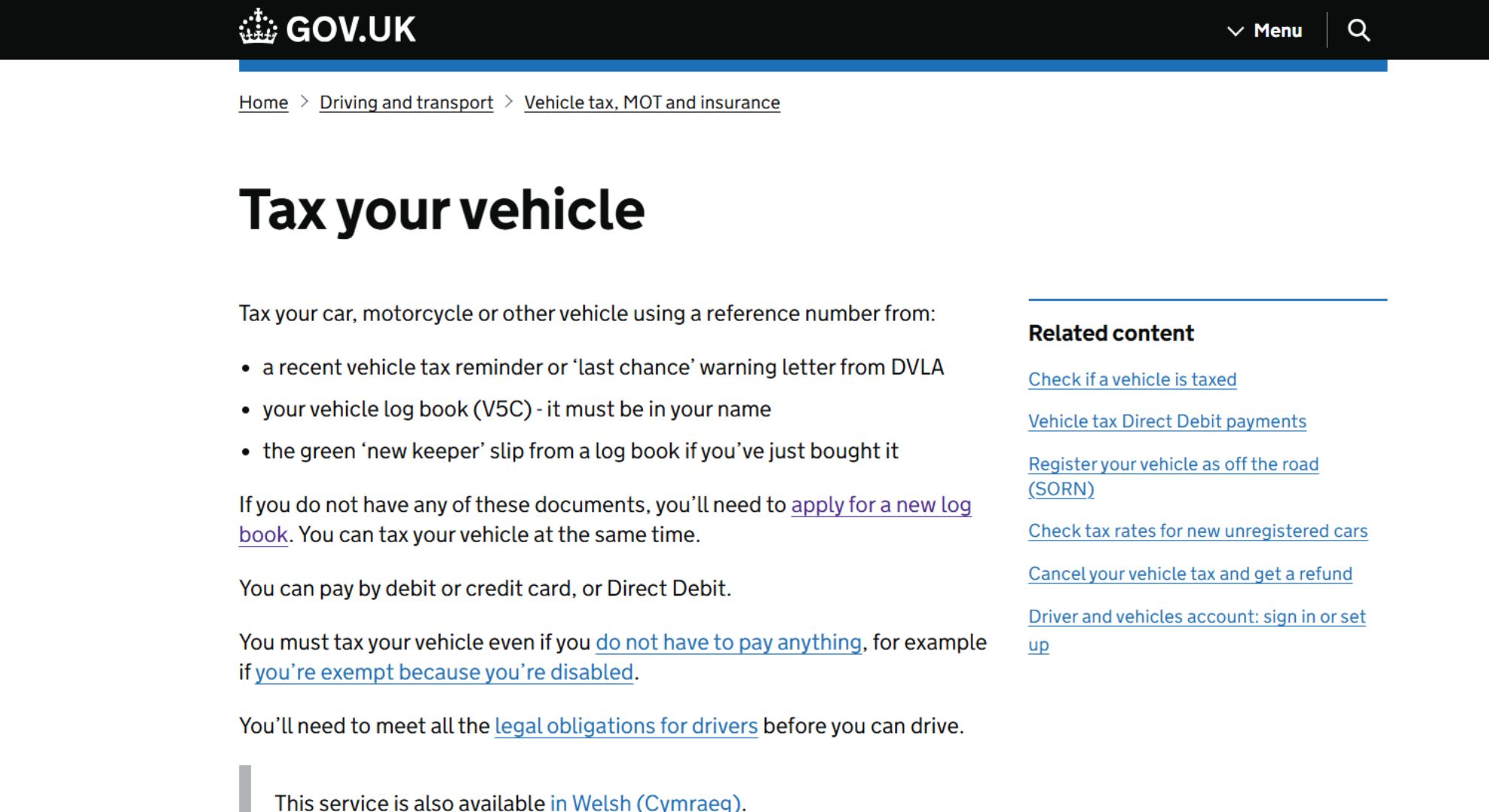
Taxing your car online via the GOV.UK website is the fastest and easiest method. See our 'How to tax your car' step-by-step guide for more information.
Car tax fines and penalties
You may face the following fines and penalties if you drive or park an untaxed car on public highways:
- If caught driving an untaxed car, you could be fined up to £1,000.
- If you fail to pay a car tax fine, the case could be escalated to a magistrates' court – and you may be liable to pay a penalty of £1,000 or five times the initial penalty amount (whichever is higher).
- You may face a £2,500 penalty if caught driving or parking an untaxed vehicle on a public highway whilst you have a statutory off road notification (SORN) in place.
- Your vehicle may also be clamped, in which case, a £100 release fee will apply for the first 24 hours. Once your vehicle has been removed, the release fee will increase to £200, together with a storage fee of £21 for each day your vehicle is impounded.
Our guide 'Driving without tax' explains this topic in more detail.
How often do you need to tax your car?
Road tax must be paid annually.
When your new car is first registered, you must pay for 12 months' road tax upfront. This is known as the 'showroom tax'. This tax must be paid before you can legally drive the vehicle away.
After this, you can choose to pay your road tax monthly or in 6- or 12-month periods at different rates.
If you pay by Direct Debit, your next payment will automatically be taken when a new tax year starts. However, if you paid by credit/debit card, it's your responsibility to set up a new payment.
How does the DVLA monitor road tax?
The DVLA keeps all road tax records on an electronic database.
Modern speed cameras (including those mounted to police cars) are fitted with Automated Number Plate Recognition (ANPR) technology. This allows them to instantly check the DVLA's database to determine whether passing cars are taxed.
Road tax and selling your car
In 2014, the physical tax disc system was disbanded – and the car tax system was brought online, meaning it was no longer possible to transfer outstanding road tax when selling a car.
When you buy a car, you must tax it before driving away. If you sell your car, you must notify the DVLA – and you can also claim a car tax refund for any full months' unused cover.
Frequently Asked Questions
Road tax is a mandatory annual tax that applies to most vehicles that are driven or parked on UK roads.
The money collected goes to the Exchequer and may be spent on a variety of public services and amenities, such as hospitals, police forces and community projects, in addition to road works and maintenance.
Responsibility for the upkeep of UK roads lies with the Department of Transport, who distribute money allocated to them by the Exchequer to the Highways Agency (who maintain the UK's strategic road network) and local authorities (who are responsible for the maintenance of all roads except motorways and significant A-roads).
Road tax must be paid annually.
When your new car is first registered, you must pay for 12 months' road tax upfront. This is known as the 'showroom tax'. This tax must be paid before you can legally drive the vehicle away.
After this, you can choose to pay your road tax monthly or in 6- or 12-month periods at different rates.
If you pay by Direct Debit, your next payment will automatically be taken when a new tax year starts. However, if you paid by credit/debit card, it's your responsibility to set up a new payment.
The DVLA keeps all road tax records on an electronic database.
Modern speed cameras (including those mounted to police cars) are fitted with Automated Number Plate Recognition (ANPR) technology. This allows them to instantly check the DVLA's database to determine whether passing cars are taxed.
Vehicle Excise Duty (VED) is the official term for vehicle tax, car tax or road tax. It is a mandatory annual tax that must be paid by most owners of UK-registered cars, vans, motorcycles and other motor vehicles.
The amount of VED payable depends on a variety of factors such as the vehicle type, its age and CO2 emissions level (or engine size). VED rates are set by the Government and adjusted in line with inflation.
- For cars registered before 1st March 2001, VED is calculated based on engine size.
- For cars registered after 1st March 2001, VED is calculated based on the vehicle's CO2 emissions.
- An expensive car supplement is also added to the road tax between the second and sixth year for cars with a list price exceeding £40,000 (and EVs priced over £50,000).
On 1 April 2026, the flat annual car tax rate increased to £200, marking a £5 increase from the 2025/26 tax year.
The amount of CO2 (carbon dioxide) that a car emits is measured in grams per kilometre (g/km) and indicates its ecological credentials.